


TL;DR
Setting up a mental health practice brings big choices about legal safety and money. Many practitioners ask Should Therapists Form an LLC to guard personal savings and reduce tax burdens. Creating a formal business entity shields your personal wealth from office debts while creating a smooth path for long-term growth.
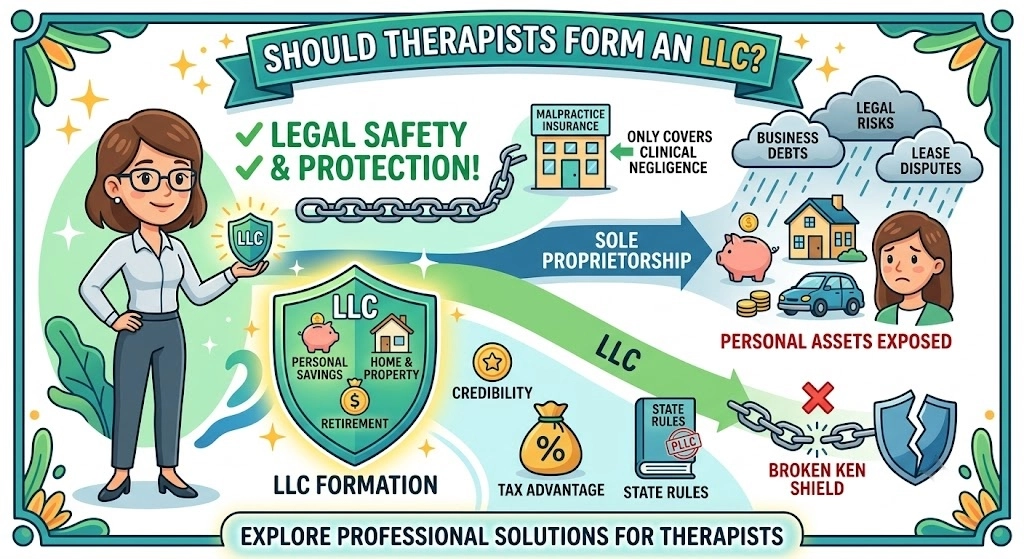
When starting a private practice, one major question always comes up: Should Therapists Form an LLC? Many healthcare providers begin working as sole proprietors without understanding the risks. Running a mental health practice without legal protection leaves your personal bank account, house, and personal items open to unexpected business debts. Choosing the right business entity helps you build a strong foundation so you can care for clients with total peace of mind.
Why Business Structure Matters for Mental Health Providers
Starting your career in private practice feels exciting, but it brings real business responsibilities. Every counselor must decide how to organize their work under state law. If you do not choose a formal legal structure, your state treats you as a sole proprietor automatically. This default option seems easy because it requires no state registration fees or formal paperwork. However, it creates a risky blend between your personal life and business money.
When you operate as a sole proprietor, you and your business count as the same legal entity. If your practice faces a lease dispute, vendor conflict, or unpaid bill, creditors can go after your personal savings. Deciding to complete a therapist LLC formation creates a clear legal wall between your personal wealth and your practice expenses. This separation ensures that business obligations stay inside the business.
Beyond risk control, having an official company structure builds instant credibility with clients, landlords, and insurance networks. People trust a practice that operates as a recognized commercial entity. It shows that you treat your clinical work as a serious, long-term venture. Setting up a dedicated business foundation also allows you to secure a professional Virtual Office location to keep your home address private and protected.
Personal Asset Protection vs Malpractice Insurance
Many mental health professionals assume that buying malpractice insurance gives them total coverage against every legal issue. While professional liability coverage is essential for every clinician, it only covers clinical claims like alleged negligence or improper care. It does not cover commercial problems like slip and fall accidents in your waiting area, contract breaches, or office lease disputes.
This is where true liability protection becomes critical for your practice. A Limited Liability Company creates a corporate shield that limits financial risk to the assets owned by the business. If someone sues your practice for a non-clinical issue, they can only target business bank accounts and assets. Your personal house, family car, and individual retirement savings remain protected behind that legal barrier.
To maintain this legal barrier, you must keep business activities completely separate from personal affairs. You should always use dedicated business accounts, sign contracts under the company name, and follow basic corporate record-keeping. Combining personal funds with practice revenue can break your legal shield during a dispute. You can review official guidance on choosing a business structure through the U.S. Small Business Administration to see how entity choices protect personal assets.
LLC Tax Benefits and Costs for Therapists
Understanding business taxes helps you save money and keep more of your earnings. By default, a single-member Limited Liability Company uses pass-through taxation. This means the business itself does not pay federal income tax. Instead, practice profits pass through directly to your personal tax return, avoiding double taxation issues.
As your income increases, this structure offers special tax choices that lower your self-employment tax burden. Standard sole proprietors pay tax on all net income. An established entity can choose to be taxed as an S Corporation once earnings reach a certain level. Under this setup, you pay yourself a reasonable salary and take remaining profits as owner distributions, which can lower total tax payments.
Comparing your options helps you select the best path for your clinical practice goals. Here is how common structures compare for mental health professionals:
| Business Entity Type | Personal Liability Shield | Tax Flexibility Options | Setup Complexity |
| Sole Proprietorship | No protection provided | Basic personal tax return | Zero formal paperwork |
| Standard LLC | Protects personal assets | Pass-through or corporate taxation | Moderate state filing |
| Professional LLC (PLLC) | Strong asset protection | Pass-through or S Corp choice | Requires state license proof |
| S Corporation Election | Strong asset protection | Reduces self-employment tax | High accounting requirements |
Evaluating these choices shows clear financial reasons why counselors move away from sole proprietorships. Reviewing clear Pricing structures for business setup resources helps you plan expenses without surprising fees along the way. Using smart tax planning keeps your practice financially sound year after year.
LLC and PLLC Requirements for New York Therapists
State laws dictate how mental health professionals form business entities. Some states allow counselors to form standard Limited Liability Companies. Other states mandate that licensed professionals form a professional limited liability company or a professional corporation. These rules ensure that licensed providers maintain accountability for their specialized services.
States like New York and California have strict guidelines regarding professional services. In these areas, state licensing boards must approve your company documents before you submit them to the state filing office. They review your license status and verify that your proposed company name follows professional naming conventions. You must research your local state board requirements before submitting paperwork.
Every state also requires a physical address for legal notices and public records. Many therapists who offer online sessions prefer not to list their home addresses on public state databases for safety reasons. Utilizing dedicated Mail Forwarding services provides a legitimate commercial address for state forms while keeping your domestic address private. You can verify federal business tax rules directly on the Internal Revenue Service website.
How to Form an LLC or PLLC for a Therapy Practice
Once you decide to move forward, following a clear step-by-step process makes setup straightforward. First, select a unique name for your practice that complies with state rules and professional board standards. Make sure the name includes required terms like LLC or PLLC as dictated by local regulations.
Second, designate a registered agent in your state to receive official legal notices. Third, prepare and file your Articles of Organization with your state business filing office. After receiving state approval, apply for a Federal Employer Identification Number from the federal government. This number acts as a Social Security number for your company and lets you open business accounts.
Fourth, draft a comprehensive operating agreement to establish practice rules, even if you are the sole owner. Fifth, open a dedicated business checking account and transfer all practice income and expenses away from personal accounts. Connecting with a supportive professional Community gives you valuable insights from peers who have already completed this business process.
Strategic Realities of Practice Ownership
Running a successful practice requires balancing legal safety with daily client care. Protecting your hard-earned money lets you focus on providing outstanding therapy without constant stress about business liability. Setting up proper entity structures shows clients and professional peers that you run a high-quality, reliable healthcare practice.
Taking proactive steps early in your private practice journey saves time, money, and stress down the road. Rather than waiting for a contract issue or audit to occur, putting a strong legal foundation in place today secures your professional career. Proper business planning allows you to grow your client base with confidence.
Frequently Asked Questions
Is an LLC mandatory for mental health counselors in private practice?
An entity setup is not legally mandatory for private practice counselors, but operating without one leaves your personal assets vulnerable to business debts, client slip and fall injuries, and commercial lease disputes.
Does an LLC protect me from clinical malpractice claims?
No entity structure shields your personal assets from claims of direct clinical negligence. Malpractice insurance covers clinical mistakes, while your business entity shields personal savings from commercial liabilities and lease debts.
What is the main difference between an LLC and a PLLC?
A standard entity can be formed by any business owner, whereas a professional entity is specifically required in certain states for licensed professionals like therapists, doctors, lawyers, and certified public accountants.
Can a single therapist form a business entity alone?
Yes, a single practitioner can easily form a single-member entity. It offers the exact same asset protection benefits and tax advantages as multi-member structures while keeping daily management straightforward.
How much does it cost to set up a practice entity?
State filing fees generally range from fifty dollars to several hundred dollars depending on location. You may also have ongoing annual report fees, registered agent expenses, and state licensing board confirmation costs.
Can I form an entity if I only offer telehealth therapy?
Yes, online providers benefit significantly from formal entity structures. Telehealth practitioners still face commercial liabilities, technology vendor contracts, software platform agreements, and federal tax obligations that require legal business protection.
Should I choose S Corp tax status for my therapy practice?
Electing S Corp tax treatment makes financial sense once your net practice earnings reach a steady level. It allows you to pay yourself a salary and reduce self-employment taxes on remaining business profits.
Can I use my home address to register my practice entity?
While legally permissible in many areas, using a home address exposes your residential location on public state databases. Using a professional virtual office address protects your family safety and personal privacy.
Do I still need a separate business bank account after setup?
Yes, maintaining a separate business checking account is legally required to preserve your corporate liability shield. Mixing personal and business funds can destroy your legal protection during court or debt disputes.
Can therapists form a regular LLC in New York?
Therapists providing licensed clinical services in New York must follow the state’s professional entity rules. Depending on their license and services, they may need a Professional Limited Liability Company (PLLC), Professional Corporation (PC), or another authorized practice structure. A standard LLC does not automatically qualify to provide licensed therapy services.
Does forming an LLC reduce taxes for self employed therapists?
Forming an LLC does not automatically lower a therapist’s federal income taxes. The IRS generally treats a single member LLC as a disregarded entity unless its owner elects another tax classification. Certain eligible businesses may elect S Corporation taxation, but the financial benefit depends on income, reasonable compensation, payroll costs, and individual circumstances.
Should a therapist choose a PLLC or sole proprietorship?
The appropriate structure depends on the therapist’s license, location, business risks, and long term plans. An eligible sole proprietor can operate without creating a separate business entity, while a PLLC may provide certain liability protections and a formal ownership structure. Therapists should verify state licensing rules and consult qualified legal and tax professionals before making a decision.
Key Takeaways
- Forming a business entity creates a legal wall that shields personal savings, vehicles, and real estate from commercial practice liabilities.
- Malpractice insurance covers clinical errors, but a formal business structure guards against commercial contracts, facility accidents, and financial disputes.
- High-earning practitioners can lower self-employment taxes by choosing S Corp tax status for their registered business structure.
- Many states require licensed health providers to form a specialized professional entity rather than a standard commercial structure.
- Using a commercial virtual address keeps your residential address off public databases while satisfying state filing standards.
Elevate Your Practice With Professional Office Solutions
Building a safe and profitable private practice requires the right legal setup and professional workspace resources. Setting up your business entity protects your personal financial future so you can focus entirely on delivering exceptional clinical care. Having a respected commercial presence enhances your professional image and builds immediate trust with incoming clients.
Therapy Hive NYC provides flexible virtual office plans, commercial address services, mail management, and vibrant community spaces tailored specifically for mental health professionals. Let us handle your practice address and workspace requirements while you build your practice. Explore our specialized services today to establish a secure foundation for your clinical business.