


TL;DR
Mental health clinicians frequently ask whether practicing online from a residence meets state regulations. Yes, can therapists work from home in New York is a question with a clear answer: providers can treat clients remotely if they maintain proper state licensure, ensure privacy, and follow billing rules.
Can therapists work from home in New York while building a successful private practice? Yes, licensed mental health professionals in New York can provide telepractice services from a home office. State board rules allow social workers, psychologists, counselors, and marriage and family therapists to conduct remote therapy sessions.
Licensing and Legal Requirements for NY Remote Practice
Operating a virtual practice requires following state law. When clinicians ask whether therapists can work from home in New York, they must look closely at licensing board requirements. The state mandates that treatment occurs where the client sits during the appointment.
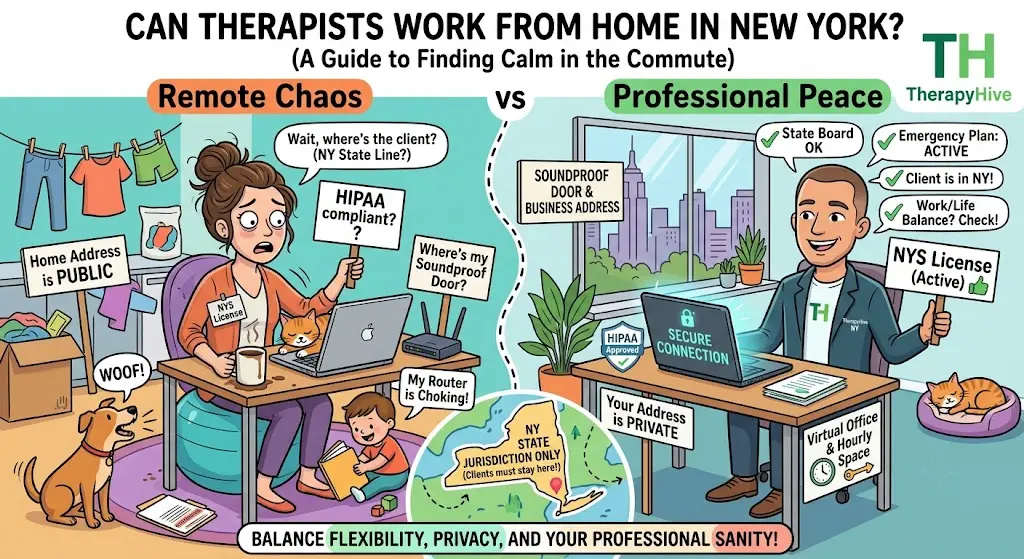
Core Compliance Requirements for NY Practice
- Active NYS License: You must be licensed by the New York State Education Department Office of Professions.
- Client Location Rule: The client must be physically present within New York State during the session.
- HIPAA Protocols: You must sign a Business Associate Agreement with end-to-end encrypted video platforms.
- Address Privacy: You need a secure, professional business address for public directory listings.
- Crisis Management Plan: You must establish local emergency procedures for the client’s physical location.
Key compliance standards include:
- State Board Jurisdiction: Your license must match the client’s physical location during care. Treating a client who is traveling out of state may require temporary practice permissions in that secondary location.
- Emergency Planning: You must document the physical address of your client at the start of every virtual appointment. You must also maintain local emergency contact numbers for the client’s city or town.
- In-Person Assessment Needs: Certain clinical conditions require face-to-face evaluations. Having access to flexible physical space allows you to switch smoothly between remote and in-person care when client safety demands it.
Clinicians who want to learn more about our founding mission and professional space standards can read About TherapyHive to see how modern practice solutions support licensed mental health professionals.
Privacy, Security, and Confidentiality Standards
Providing remote care from home means turning a personal space into a secure clinical office. Privacy rules apply just as strictly to home environments as they do to traditional medical clinics.
Home Office Privacy Checklist
- Closed door with dedicated soundproofing
- White noise machine placed outside the room
- Encrypted Wi-Fi network with active VPN security
- HIPAA-compliant video software with a signed BAA
- Locked storage cabinet for any physical records
Essential Home Office Setup Standards
To maintain full compliance while working from home, providers must establish clear boundary controls:
- Acoustic Privacy: Sessions must never be overheard by family members, roommates, or visitors. Using white noise generators, soundproof door seals, and commercial headsets helps protect spoken dialogue.
- Digital Security: Providers must conduct sessions using encrypted, HIPAA-compliant telehealth software. Standard consumer video applications do not meet legal encryption standards unless a signed Business Associate Agreement (BAA) is active.
- Document Safety: Digital records must sit behind two-factor authentication. Any printed notes or client files must stay inside a locked cabinet in a dedicated room.
Research shows that virtual care delivers strong clinical outcomes when privacy standards are strictly preserved. You can examine peer-reviewed findings on virtual treatment efficacy in the National Institutes of Health Telehealth Study.
For clinicians who prefer dedicated remote support without high overhead expenses, utilizing a Virtual Office NYC plan provides a compliant business structure along with complete home address privacy.
Practice Model Comparison: Remote, Hybrid, and Physical Office
Choosing how to structure your practice affects your monthly expenses, work-life balance, and client retention. Evaluating whether therapists can work from home in New York involves comparing operational costs against professional benefits.
| Feature | Home-Only Practice | Hybrid Practice Model | Dedicated NYC Office |
| Monthly Overhead | Low (software and Internet) | Moderate (flexible rental costs) | High (fixed long-term lease) |
| Address Privacy | Risk of exposing home address | Full privacy with commercial address | Full privacy at leased address |
| Clinical Versatility | Telehealth clients only | Both remote and in-person sessions | Primary focus on in-person care |
| Client Accessibility | Limited to online care | Maximum flexibility for client choice | Limited to local commuters |
| Work-Life Boundaries | Harder to separate home/work | Clear physical separation when needed | Distinct physical boundary |
A hybrid approach allows you to keep overhead low while preserving the option to meet clients face-to-face when clinical situations require an in-person room.
Building Professional Credibility and Client Trust
While many patients appreciate virtual sessions, public trust often hinges on professional presentation. Displaying a residential street address on public license registries, insurance portals, or online marketing materials can raise safety and boundary concerns.
Protecting Your Personal Privacy
Using a personal residence address for public listings presents major drawbacks:
- Boundary Violations: Unannounced client visits or unexpected mail deliveries at your private residence can disturb your personal life.
- Marketing Perception: Potential clients often look for a central, professional practice location when selecting a provider.
- Insurance Requirements: Commercial payers and state boards often require a recognized business location for credentialing records.
By choosing a dedicated professional business address, clinicians protect their personal safety while building a strong brand. Joining The Hive Directory gives clinicians higher online visibility and connects them with a supportive network of licensed colleagues.
Modern Space Solutions for Hybrid Practice Growth
Many practitioners find that working exclusively from home leads to isolation or burnout. Combining home-based telehealth with flexible physical space creates a balanced, sustainable career.
The Hybrid Practice Workflow
- Home Office: Conduct flexible virtual telehealth sessions during your week.
- Virtual Address: Maintain complete HIPAA and business address privacy on public registries.
- On-Demand Space: See clients in person at a professional suite whenever face-to-face care is needed.
Flexible Physical Office Options
Rather than signing expensive, multi-year commercial leases, providers can use flexible workspace models:
- Hourly Space Rental: Reserve furnished, soundproof rooms only for the exact hours you meet in-person clients. You can book an On-Demand Hourly Office to keep costs directly aligned with your weekly caseload.
- Commuter-Friendly Locations: Selecting central suites near major transit hubs simplifies travel for both provider and patient. Clinicians looking for accessible space near transit hubs can review Therapy Office Space Near Queens NY to support commuting clients across the city.
- Professional Business Address: Maintain a prestigious Manhattan address for licensing, mail handling, and insurance directories while working primarily from home using a trusted Virtual Office membership.
Balancing Professional Standing and Flexible Work
Answering whether therapists can work from home in New York is only the first step in designing your practice. The real goal is constructing a long-term practice model that protects your well-being, fulfills legal duties, and provides exceptional client care.
Working from home offers convenience and flexibility, but combining home telehealth with professional business tools creates the best environment for long-term growth.
Frequently Asked Questions
Can therapists work from home in New York without an office?
Yes, licensed therapists can work entirely from home in New York. You must maintain strict HIPAA compliance, secure confidential patient records, and ensure your clients sit physically within state borders during sessions.
Where must the client be located during a remote session?
New York state law requires that the client be physically located inside New York during care. If a client travels out of state, you must check that state’s telepractice rules before treating them.
Do NY insurance panels cover remote mental health care?
Most commercial insurance plans and New York Medicaid cover telehealth services. You must verify individual payer policies, use correct billing modifiers, and ensure your telehealth platform meets full state encryption guidelines.
Can I use my personal home address for official licensing?
While legally allowed, using a home address exposes your private residence on public state registries. Most clinicians prefer a professional virtual business address to maintain safety, privacy, and commercial credibility.
What HIPAA software is required for telepractice in New York?
Therapists must use video platforms that offer end-to-end encryption and sign a formal Business Associate Agreement. Standard consumer apps without BAAs do not meet state or federal privacy standards for clinical practice.
How do I handle mental health crises while working remotely?
You must collect and confirm your client’s exact physical address at the start of every session. You must also keep local emergency service numbers on hand for the client’s current city or town.
Can out-of-state therapists treat clients living in New York?
Out-of-state clinicians can treat clients located in New York only if they hold an active New York state license. License reciprocity rules vary, so providers must confirm state board credentials first.
What are the main benefits of a hybrid practice model?
A hybrid model combines the low overhead of home telehealth with the professional credibility of in-person care. It allows providers to see local clients face-to-face while maintaining flexible virtual work schedules.
How does a professional Manhattan address help remote therapists?
A professional address keeps your home location private, satisfies insurance credentialing standards, builds patient trust, and provides secure mail forwarding without paying for expensive, permanent commercial office leases.
Key Takeaways
- Full Legal Permission: Licensed New York mental health professionals can legally treat clients remotely from a home office setting.
- Mandatory Location Tracking: Telehealth rules dictate that the patient must be physically located within New York State during the session.
- Privacy and HIPAA Compliance: Remote providers must use encrypted, BAA-backed software, secure Wi-Fi, and soundproof rooms to protect client data.
- Address Protection: Utilizing a virtual business address protects your private residence while maintaining professional credibility on public registries.
- Hybrid Versatility: Combining home telehealth with hourly office rentals gives clinicians low overhead, complete schedule control, and in-person care options.
Transform Your Practice with TherapyHive Solutions
Ready to build a flexible, fully compliant private practice in New York? TherapyHive offers tailored solutions designed specifically for modern mental health practitioners.
Protect your personal boundaries, connect with a vibrant community of licensed colleagues, and grow your caseload on your own terms. Explore our membership options today and take your New York practice to the next level.