


You finished your training. You have your license. And you are ready to stop working for someone else and start building something of your own. But where do you actually begin?
The complete checklist for starting a private practice is longer than most new therapists expect. Miss one item and you could face compliance problems, cash flow gaps, or a practice that never gets found by the clients who need you.
This guide covers every item on the list, organized by practice type and easy to follow. Whether you are going fully virtual, hybrid, or in-person, this is the private practice startup checklist that gives your business a real foundation.
Spaces like TherapyHive are built specifically to simplify this process for therapists. You will see how throughout this guide.
Use up and down arrow keys to resize the meta box pane.
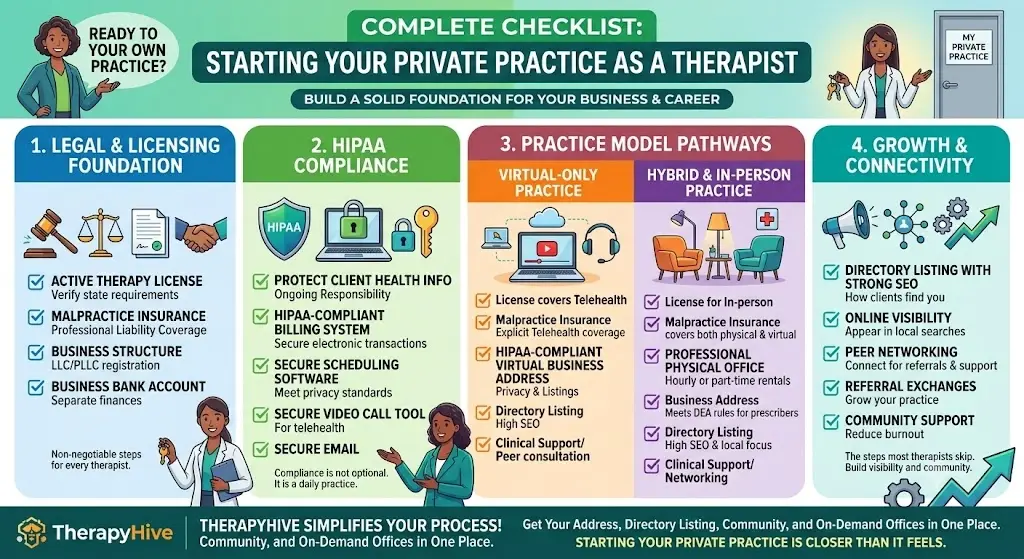
1. Legal and Licensing Requirements for Starting a Private Practice
Before anything else, your license must be active and in good standing in the state where you plan to practice. This sounds obvious, but many therapists overlook the specific requirements that apply when they move to private practice from an agency or supervised role.
Use up and down arrow keys to resize the meta box pane.
Here is what you need to confirm before seeing a single private practice client:
- Active therapy license: Confirm it is current, unrestricted, and valid for independent practice in your state.
- Malpractice insurance: Every private practice therapist needs professional liability coverage. This is non-negotiable whether you see one client or one hundred.
- Business structure: Most therapists register as an LLC or PLLC (Professional Limited Liability Company). This separates your personal finances from your business and provides legal protection.
- Business bank account: Never mix personal and professional funds. Open a dedicated business account before you bill your first client.
These four items form the legal backbone of your private practice startup checklist. Without them, everything else you build sits on a shaky foundation.
2. HIPAA Compliance for Therapists in Private Practice
HIPAA is the law that protects your clients’ private health information. It applies to you whether you work in a hospital, a coworking suite, or from your living room. Compliance is not a checkbox. It is an ongoing responsibility.
According to the U.S. Department of Health and Human Services HIPAA for Professionals, health care providers who conduct electronic transactions must comply with HIPAA privacy and security standards. As a therapist billing clients or insurers electronically, this applies directly to you.
Your HIPAA-compliant billing system must protect all electronic protected health information. Your scheduling software, payment platform, video call tool, and email must all meet these standards.
For virtual-only therapists, the HHS HIPAA guidance for mental health providers is particularly relevant. It clarifies how therapists must handle client information shared in digital environments, including telehealth sessions and electronic records.
TherapyHive members who use the virtual office plan receive a HIPAA-compliant professional business address with mail forwarding built in. This solves a common compliance gap for telehealth therapists who operate without a physical office.
3. Practice Model Comparison: Virtual-Only vs. Hybrid & In-Person
Choosing between a fully remote setup and a physical office affects your upfront costs, legal registrations, and daily operations. To help you map out your path, this table compares the foundational needs for both virtual-only practices and hybrid/in-person setups side-by-side.
| Checklist Requirement | Virtual-Only Practice | Hybrid & In-Person Practice |
| Therapy License | Valid for telehealth in your home state | Valid for physical practice in your state |
| Malpractice Insurance | Required (must explicitly cover telehealth) | Required (must cover physical & virtual care) |
| Business Setup & Banking | LLC/PLLC + separate business bank account | LLC/PLLC + separate business bank account |
| Privacy Compliance | HIPAA-compliant billing, video, & digital tools | HIPAA-compliant billing & secure on-site filing |
| Business Address | Virtual business address for privacy & listings | Physical address (must meet DEA rules for prescribers) |
| Physical Space | None (work from home or a remote space) | Hourly or part-time professional office rentals |
| Marketing & Growth | High-SEO directory listing & digital networking | High-SEO directory listing & local peer referrals |
| Clinical Support | Peer supervision or consultation groups | Peer supervision or consultation groups |
4. The Virtual-Only Private Practice Checklist
Running a telehealth-only practice is now a mainstream model. It is cost-effective, flexible, and expands the reach of mental health care. But it comes with its own specific requirements on the complete checklist for starting a private practice.
If you are virtual only, here is your full startup list:
- Active therapy license valid for telehealth in your state
- Malpractice insurance that explicitly covers telehealth practice
- Business structure (LLC or PLLC as appropriate for your state)
- Business bank account separate from personal funds
- HIPAA-compliant billing system for all electronic claims and payments
- Professional HIPAA-compliant virtual office address for your business registration, professional listings, and mail
- Directory listing with strong SEO so clients can find you online
- Access to networking opportunities with other therapists for referrals and peer support
- Individual or group supervision, if required by your licensure or simply recommended for professional growth
The TherapyHive virtual office plan covers the virtual address, mail forwarding, and directory listing in one membership. Three items on this list, handled at once. The TherapyHive directory is built for SEO and connects clients with therapists in private practice.
5. The Hybrid and In-Person Private Practice Checklist
If you see clients in person, even part of the time, your private practice startup checklist expands. You need physical space that meets professional and legal standards. And if you are a medical prescriber, your space must also meet DEA and state registration requirements.
Here is the full checklist for hybrid therapists and medical prescribers:
- Active therapy license for in-person practice in your state
- Malpractice insurance covering both in-person and telehealth if applicable
- Business structure (LLC or PLLC)
- Business bank account
- HIPAA-compliant billing system
- Access to a professional office on an hourly or part-time basis
- Professional business address that meets DEA and state licensing requirements if you prescribe
- Directory listing with SEO to attract new clients
- Networking access for referrals and collegial support
- Individual or group supervision as needed
TherapyHive offers on-demand hourly office rentals and part-time office memberships at a prestigious 5th Avenue address in New York City. The Honeybee plan ($149/month) is also DEA-compliant for medical prescribers.
6. Directory Listings, SEO, and Networking: The Items Most Therapists Skip
Getting licensed and insured is the part therapists focus on most. Building visibility and community is the part most therapists delay. And yet, without clients finding you and colleagues supporting you, the rest of the checklist does not produce income.
A listing on a professional directory with good SEO is not a nice-to-have. It is how clients find therapists today. People search for therapists the same way they search for dentists or restaurants. If your name does not appear in search results, you simply do not exist to potential clients.
TherapyHive’s therapist directory is built with SEO at its core. Every profile is indexed and ranked for local and specialty-specific searches. This is different from generic platforms that list thousands of names with little structure.
Peer referrals also drive a large share of private practice growth. When a colleague is full or cannot serve a client’s need, they refer out. If you are not in their network, you are not on that list.
TherapyHive’s therapist-only Discussion Board gives members a secure space to connect and exchange referrals. Explore membership options on the pricing page. For questions, the TherapyHive FAQ page covers all plan details.
Build Your Practice on a Strong Foundation From Day One
The complete checklist for starting a private practice is not just a to-do list. It is a blueprint for building something sustainable. Every item exists for a reason. Skip one, and you leave a gap that will cost you time, money, or compliance headaches later.
TherapyHive was created by a therapist who went through this exact process. The memberships close the most common gaps: the address, compliance, directory presence, and community. Whether you need a full-time office or just a virtual address and listing, there is a plan for your needs.
Visit the TherapyHive contact page to ask questions or get started. Your private practice is closer than it feels right now.
Frequently Asked Questions
1. What is the complete checklist for starting a private practice as a therapist?
The checklist includes an active license, malpractice insurance, business structure, bank account, HIPAA-compliant billing, a professional address, a directory listing with SEO, networking access, and individual or group supervision depending on your license and practice model.
2. Do I need an LLC to start a private practice?
Most therapists register as an LLC or PLLC to protect personal assets and separate professional finances. Requirements vary by state. Check your state licensing board and consult a business attorney before choosing your structure when starting your private practice.
3. What does HIPAA compliance mean for a private practice therapist?
HIPAA requires you to protect all client health information. Your billing software, scheduling tools, email, and video platform must all meet federal standards. This applies to both in-person and virtual therapists who conduct electronic billing or store digital records.
4. Do virtual-only therapists need a professional business address?
Yes. A professional HIPAA-compliant business address is required for business registration, professional licensing, and directory listings. TherapyHive’s virtual office plan provides a 5th Avenue NYC address with HIPAA-compliant mail forwarding for fully remote therapists.
5. How do clients find private practice therapists online?
Most clients search online using terms like therapist near me or therapist specializing in anxiety. A directory listing with strong SEO makes your profile visible in those searches. TherapyHive’s directory is built with search engine optimization specifically for mental health private practices.
6. What is the difference between a virtual office and an on-demand office for therapists?
A virtual office provides a professional business address and mail forwarding without physical space. An on-demand office is a physical room you book by the hour when you need to see clients in person. TherapyHive offers both options to fit different practice models.
7. How important is supervision when starting a private practice?
Supervision requirements depend on your license type and state. Some licenses require ongoing supervision. Even when not required, peer or group supervision is strongly recommended. It supports clinical quality, prevents burnout, and keeps your practice grounded in best practices.
8. Can a medical prescriber use TherapyHive’s office for DEA registration?
Yes. The Honeybee membership plan at TherapyHive meets DEA and state registration requirements for medical prescribers. It includes access to hourly office space, a virtual address, HIPAA-compliant mail forwarding, and a profile on the Hive therapist directory.
9. Where can I learn more about TherapyHive membership plans for private practice?
Visit the TherapyHive pricing page for a full breakdown of all plans, including the free Hive listing, the Carpenter Bee virtual plan, and the Honeybee hybrid plan. The FAQ page answers common questions about membership features.